


-
 By:
Alex Herrera
By:
Alex Herrera
-
 Editor:
Phyllis Rodriguez, PMHNP-BC
Editor:
Phyllis Rodriguez, PMHNP-BC
-
 Clinical Reviewer:
Dr. Ash Bhatt, MD, MRO
Clinical Reviewer:
Dr. Ash Bhatt, MD, MRO
While recovery can be difficult at times, those who suffer from co-occurring mental health conditions face unique challenges on their journey of sobriety. If a person suffers from co-occurring disorders but is left undiagnosed, they may be more susceptible to relapse upon their discharge from treatment.
Since symptoms of mental illness and symptoms of addiction can be overlapping, mental illness often goes overlooked.
Co-occurring Disorders
Co-occurring disorders are used to describe the occurrence of both a mental illness and a substance use disorder. Nearly one-third of people who have depression also have a substance use disorder. Additionally, between 48% and 60%2 of those who have bipolar disorder suffer from addiction as well. Mental Health America estimates1 that, in total, 50% of the two million Americans who struggle with mental illness have a problem with drugs or alcohol. Although it can be difficult to determine whether mental illness or addiction came first, both conditions perpetuate and exacerbate the other.
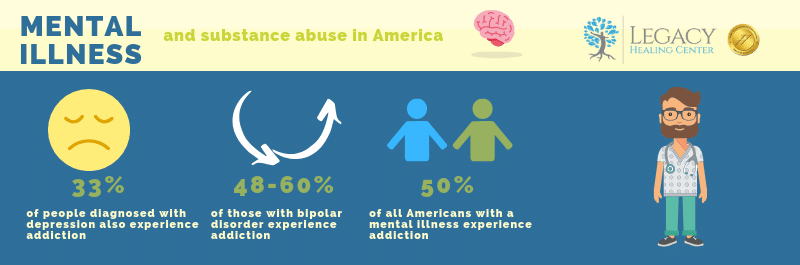
Self-medication is a common technique used among people who suffer from mental illness in an attempt to cope with symptoms like stress, anxiety, and depression. Drugs and alcohol may work well in masking symptoms of mental illness in the beginning, but it is an unhealthy coping mechanism that can easily develop into an addiction and other self-destructive behaviors. On the other hand, healthy individuals who develop a substance use disorder are prone to major chemical and structural changes in the brain. As the brain continues to change and adapt, mental illness is likely to ensue.
Individuals who experience co-occurring disorders are at an increased risk of relapse if left untreated due to the impairment they face in regards to coping skills and decision making.
When Co-occurring Disorders are Missed
Despite the high comorbidity between mental illness and substance use disorders, it can be difficult to diagnose mental illness because many symptoms mimic those of addiction.
Symptoms of mental illness that can be masked by addiction include:
- Weight loss
- Irregular sleep patterns
- Poor concentration
- Mood swings
- Impulsive behavior
- Irritability
- Depression
- Loss of interest in hobbies and activities
In settings where dual diagnosis treatment is not in place, up to 50% of depression diagnosis and 40% of bipolar diagnosis are missed.3 To optimize the course of treatment and help prevent a relapse, dual diagnosis treatment is the ideal course of action for those with a substance use disorder.
When Dual Diagnosis is Left Untreated
Living with untreated mental illness can make day-to-day life exceptionally challenging and symptoms can become worse if left untreated. Receiving proper care and dual diagnosis treatment is necessary for those who suffer from co-occurring disorders to improve their quality of life and help prepare them for sobriety.
When a dual diagnosis case is not treated, the person is more likely to relapse and begin the cycle of self-medication once again. This failure to recognize a co-occurring disorder can throw an individual into a dangerous cycle of attempting to cope with their symptoms alone, relapse, and a quick decline in emotional, mental, and physical health.
Individuals who suffer from mental illness experience higher rates of homelessness, suicide, criminal activity, and unemployment4 than their peers. When throwing addiction and recovery into the mix, an undiagnosed mental illness can lead to a recipe for disaster.
Dual Diagnosis Therapy
Dual diagnosis treatment aims to identify and treat mental illness and substance use disorders by merging addiction treatment and mental health care together. The most effective dual diagnosis treatment will create an individualized treatment plan that is suited to each person’s specific needs.
Cognitive Behavioral Therapy (CBT) is proven to be beneficial in treating co-occurring disorders. The idea behind CBT is that behaviors and decisions are formulated based on an individual’s perception of the world and their surroundings. CBT will help dual diagnosis clients to change how they think about themselves and perceive the world in order to equip them with better decision-making abilities. This form of therapy can prepare individuals with education on how to make decisions that will bring long-lasting results.
Alternative and holistic therapies are another form of treatment that takes place in dual diagnosis cases. Alternative therapies refer to a multitude of relaxation and stress-reducing techniques, such as yoga, meditation, and art therapy. Participating in these activities can help lower stress and anxiety while enhancing one’s mood and coping skills.
Another integral part of dual diagnosis therapy involves medication to treat symptoms of mental illness. Finding the right medication for each individual can help alleviate many or all of their symptoms and improve their chances of maintaining long-term sobriety.
Through dual diagnosis treatment, individuals will be able to improve their self-worth, foster healthy coping skills, and learn to manage symptoms of mental illness. Recovery is a life or death matter, making it imperative to diagnose and treat symptoms of mental illness in order to optimize the outcomes of addiction treatment.
Sources:
Mental Health America Co-Occurring Disorders and Depression
U.S. National Library of Medicine and National Institutes of Health Misdiagnosis of Bipolar Disorder
National Alliance on Mental Illness Mental Health by the Numbers